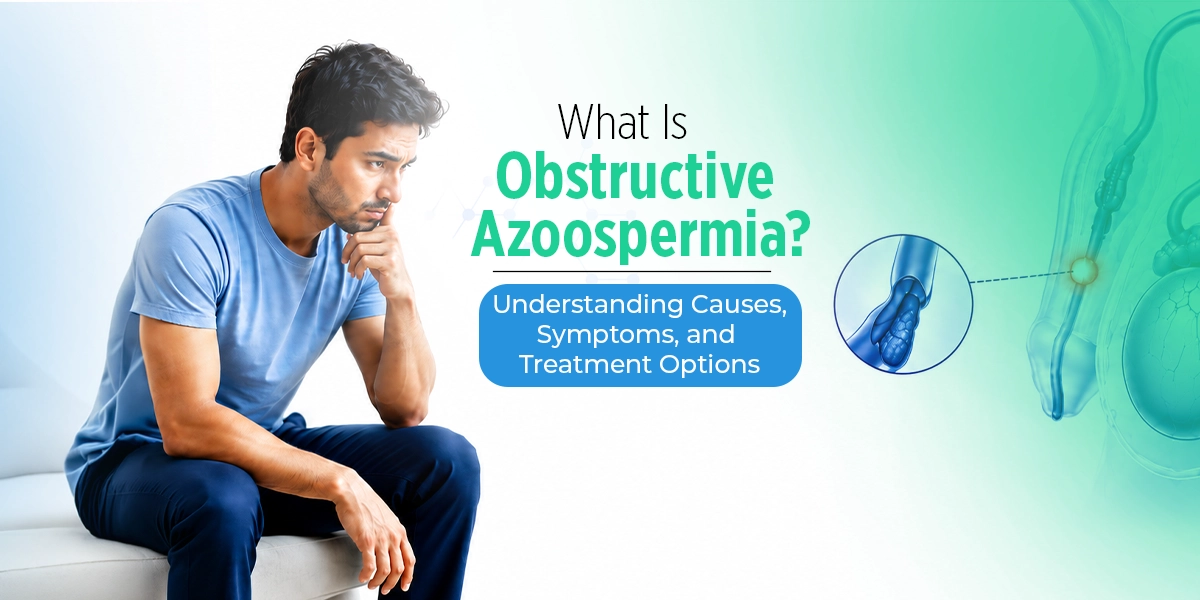
For men who receive a diagnosis of obstructive azoospermia, the news can feel overwhelming — but it is one of the most treatable causes of male infertility. Unlike other forms of azoospermia, this condition does not involve a problem with sperm production. The testes are working. The issue is that a physical blockage somewhere in the reproductive tract prevents sperm from reaching the semen.
Obstructive azoospermia accounts for roughly 40% of all azoospermia cases, and with the right evaluation and treatment, biological fatherhood remains an achievable goal for most men affected by it. This guide walks you through everything you need to know — from what causes the blockage to the surgical and assisted reproductive options that can help you move forward.
What Is Obstructive Azoospermia?
Azoospermia is the medical term for the complete absence of sperm in a man’s ejaculate, confirmed by semen analysis. It is broadly divided into two types:
Obstructive azoospermia (OA) — sperm is produced normally in the testes but is blocked somewhere along the reproductive tract (the epididymis, vas deferens, or ejaculatory ducts) before it can reach the semen.
Non-obstructive azoospermia (NOA) — the underlying issue is insufficient or absent sperm production in the testes themselves, rather than a blockage.
The distinction matters enormously for treatment. In OA, because the testes are producing sperm, that sperm can often be retrieved directly and used for fertility treatment — even when the blockage cannot be repaired surgically.
What Causes Obstructive Azoospermia?
The blockage can arise from several different sources:
Congenital absence of the vas deferens (CAVD): Some men are born without the vas deferens — the tubes that carry sperm from the testes to the urethra. This is strongly associated with mutations in the CFTR gene (linked to cystic fibrosis) and is one of the more common congenital causes of obstructive azoospermia.
Previous infections: Sexually transmitted infections such as chlamydia and gonorrhoea, or conditions like epididymitis, can cause inflammation and scarring that narrows or blocks the sperm ducts over time.
Prior surgery: Hernia repairs, vasectomies, prostate procedures, and scrotal surgeries can inadvertently damage the vas deferens or epididymis, leaving scar tissue that obstructs sperm flow.
Trauma: Physical injury to the groin, pelvis, or scrotum can also lead to ductal scarring and obstruction.
Cysts in the ejaculatory ducts or seminal vesicles: Cysts can physically compress or block the pathway through which sperm travels before ejaculation.
Symptoms: What to Watch For
Obstructive azoospermia rarely causes noticeable symptoms on its own. Most men have normal libido, normal sexual function, and a normal-looking ejaculate. It is typically discovered only when a couple investigates why they have been unable to conceive.
Possible signs that may suggest a problem include:
- Low semen volume or a “dry” ejaculation
- Scrotal pain or swelling (particularly if an infection or cyst is involved)
- A history of STIs, epididymitis, or scrotal surgery
- Known cystic fibrosis carrier status
Because the condition is often symptom-free, a semen analysis is the critical first step in evaluating male fertility whenever conception has been difficult.
How Is Obstructive Azoospermia Diagnosed?
Accurate diagnosis is essential before any treatment decision is made. A fertility specialist will typically use a combination of the following:
Semen analysis: The starting point for any male fertility evaluation. In obstructive azoospermia, semen volume may be reduced but the notable finding is zero sperm despite normal testicular function.
Hormone profile: Blood tests measuring FSH, LH, testosterone, and inhibin B help differentiate OA from NOA. In obstructive cases, hormone levels are generally within the normal range — a key indicator that sperm production itself is intact.
Scrotal ultrasound: Imaging can reveal abnormalities in the epididymis or vas deferens, including dilation that suggests a downstream blockage. A 2025 study published in Insights into Imaging (PMC) demonstrated that combined transscrotal–transrectal ultrasonography is a highly effective tool for localising the precise site of obstruction before surgical intervention.
Transrectal ultrasound (TRUS): Used to examine the prostate, seminal vesicles, and ejaculatory ducts for cysts, calcifications, or other obstructions.
Genetic testing: When congenital absence of the vas deferens is suspected, testing for CFTR gene mutations is recommended — both for treatment planning and because these mutations may be passed on to children.
Testicular biopsy: A biopsy confirms whether sperm production is taking place. In obstructive azoospermia, sperm will be found in the testicular tissue but absent in the ejaculate — confirming the blockage rather than a production failure.
Treatment Options for Obstructive Azoospermia
The good news: obstructive azoospermia is highly treatable. Treatment depends on the location and nature of the blockage, the man’s overall health, and the couple’s fertility goals.
Surgical Reconstruction
When the blockage is anatomically accessible and reversible, microsurgery offers the possibility of restoring natural sperm flow:
- Vasovasostomy — reconnects the two ends of a severed or blocked vas deferens (most commonly after a vasectomy reversal)
- Vasoepididymostomy — bypasses a blockage in the epididymis by connecting the vas deferens directly to it
- Transurethral resection of the ejaculatory ducts (TURED) — opens obstructed ejaculatory ducts through a minimally invasive approach
Success rates vary depending on how long the blockage has been present and the precise location, and not all men will achieve natural conception even after successful surgery. Your specialist will discuss realistic expectations based on your specific case.
Sperm Retrieval for IVF/ICSI
When surgery is not appropriate or does not succeed, sperm can be retrieved directly from the testes or epididymis. This is a well-established approach with high success rates in obstructive azoospermia because sperm production is normal.
Common retrieval methods include:
- PESA (Percutaneous Epididymal Sperm Aspiration) — a fine needle is used to aspirate sperm from the epididymis
- TESA (Testicular Sperm Aspiration) — sperm is aspirated directly from testicular tissue
- TESE (Testicular Sperm Extraction) — a small biopsy of testicular tissue is taken to retrieve sperm
- Micro-TESE (Microsurgical Testicular Sperm Extraction) — a microsurgical technique for identifying and extracting sperm-containing tubules under high magnification
Retrieved sperm is then used with IVF and ICSI (Intracytoplasmic Sperm Injection), in which a single sperm is injected directly into an egg. This technique is particularly effective when sperm numbers are limited, as is often the case with retrieved samples.
Assisted Reproductive Technology (ART)
Even when natural conception is not possible, IVF-ICSI gives most couples with obstructive azoospermia a strong chance of achieving pregnancy using the man’s own genetic material. Advances in sperm cryopreservation also mean that sperm retrieved during one procedure can be stored for future cycles.
The Emotional Side of Diagnosis
Being told your semen contains no sperm is a profound moment — even when, as with obstructive azoospermia, the outlook is genuinely positive. Anxiety, grief, and uncertainty are entirely normal responses. Many men describe feeling isolated with these feelings, particularly because male infertility is still rarely discussed openly.
A few things worth holding onto:
- This condition is common, treatable, and frequently results in biological children with appropriate care
- Your partner’s input and shared decision-making through the process matters enormously
- Psychological support — whether through a counsellor, fertility support group, or your clinical team — is a legitimate and valuable part of fertility care, not an optional extra
At Best Life Fertility Center, our team supports couples holistically, recognising that emotional wellbeing is as important as the clinical pathway.
When Should You See a Fertility Specialist?
If you have been trying to conceive for 12 months without success (or 6 months if your partner is over 35), both partners should be evaluated. A semen analysis for the male partner is a simple, non-invasive starting point.
You should seek evaluation sooner if you have a personal history of:
- A vasectomy or scrotal surgery
- Sexually transmitted infections or epididymitis
- Known cystic fibrosis or carrier status
- Groin or testicular trauma
Early diagnosis of obstructive azoospermia means more treatment options and better outcomes.
Expert Care at Best Life Fertility Center, Dubai
At Best Life Fertility Center, our male fertility specialists — led by Dr. Mazen Al-Dayeh, a reproductive endocrinology and infertility expert with over two decades of experience — provide a thorough, personalised evaluation for every man presenting with concerns about fertility.
From advanced sperm retrieval techniques to IVF/ICSI cycles, our team combines the latest technology with a genuinely compassionate approach. We understand that the path to parenthood can be complex, and we are here to guide you through every step.
Conclusion
Obstructive azoospermia is among the most hopeful diagnoses in male infertility. Because sperm production is not impaired, the path to fatherhood — whether through surgical correction or sperm retrieval with IVF/ICSI — remains open for the great majority of men affected. The key is accurate diagnosis and accessing the right specialist care promptly.
If you or your partner have questions about male fertility or have been told a semen analysis showed no sperm, Best Life Fertility Center in Dubai is here to help. Our experienced team will assess your situation fully and work with you to find the most effective, personalised treatment plan.
Book a consultation at bestivf.ae
Frequently Asked Questions
Q: What is the difference between obstructive and non-obstructive azoospermia?
In obstructive azoospermia, sperm is produced normally but blocked from reaching the ejaculate. Non-obstructive azoospermia involves impaired or absent sperm production itself.
Q: Can obstructive azoospermia be cured?
Many cases are surgically correctable. When surgery is not suitable, sperm retrieval combined with IVF/ICSI offers excellent success rates for most men.
Q: Is sperm retrieval painful?
Sperm retrieval procedures like PESA and TESA are performed under local or general anaesthesia. Discomfort afterwards is typically mild and manageable with over-the-counter pain relief.
Q: Will my children inherit obstructive azoospermia?
It depends on the cause. If a CFTR gene mutation is involved (linked to absent vas deferens), genetic counselling is recommended before proceeding with IVF/ICSI.
Q: How long does it take to get a diagnosis?
A semen analysis provides initial findings within days. A full workup — including hormones, ultrasound, and biopsy if needed — typically takes two to four weeks.