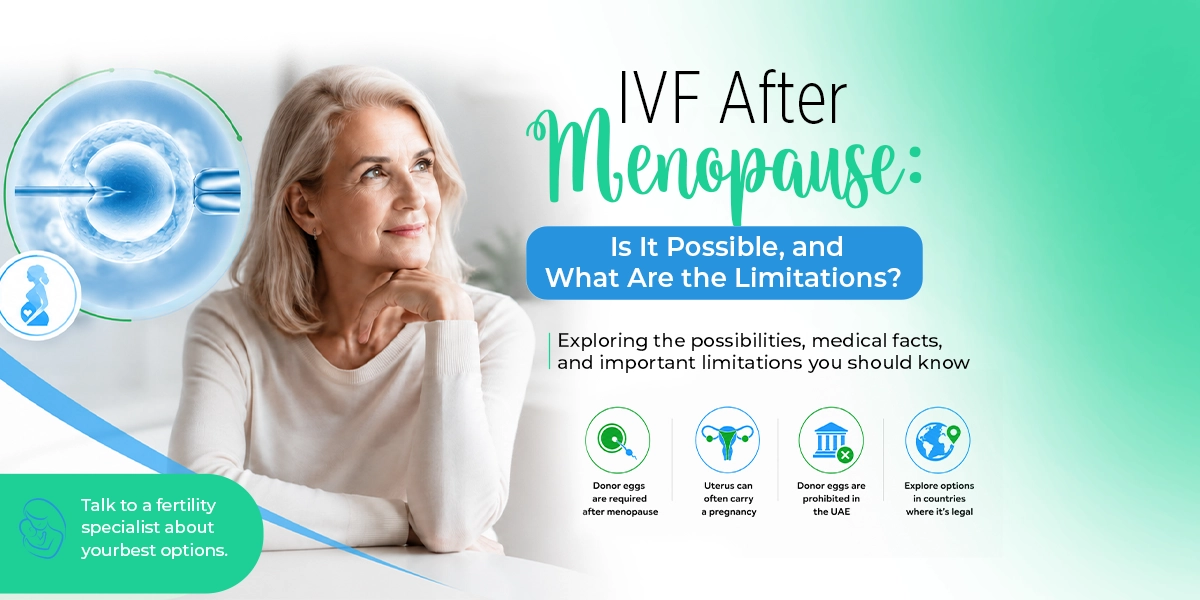
Quick Answer: Pregnancy after natural menopause is only possible through IVF using donor eggs, since a woman’s own egg supply is depleted by that point. A woman’s uterus can often still carry a pregnancy with hormonal support, but donor eggs are prohibited under UAE law, so this specific option isn’t available at clinics in the UAE. Women in this situation typically need to explore treatment in a country where donor eggs are permitted, or discuss alternative family-building paths with a specialist.
It’s one of those questions that comes up more than people expect, usually from women who assumed the conversation about fertility closed the day their periods stopped. So let’s actually answer it properly, because the honest answer to IVF after menopause is a little more layered than a simple yes or no.
What Actually Happens to Fertility After Menopause
Menopause marks the point where a woman’s ovaries have run out of viable eggs. Not fewer eggs, not lower-quality eggs, none left capable of producing a normal embryo. That’s the biological line in the sand, and no fertility treatment, however advanced, can restore a supply that’s genuinely depleted. IVF works by fertilising eggs outside the body, but it still needs an actual egg to start with, and after menopause, a woman’s own body isn’t producing one.
It’s worth pausing on that distinction, because it’s easy to assume IVF is some kind of universal fix, a way to sidestep whatever’s going wrong biologically. It isn’t. IVF is a delivery mechanism, not a source of new eggs. It can compensate for blocked tubes, poor sperm motility, or unexplained infertility in a woman with a normal egg supply, but it can’t manufacture eggs where none remain. That’s the part that trips people up most often when they first start researching this.
What doesn’t necessarily stop working, though, is the uterus. With the right hormonal preparation, oestrogen and progesterone support to rebuild the uterine lining, many postmenopausal women retain the physical capacity to carry a pregnancy. That distinction, ovaries versus uterus, is the whole reason this question doesn’t have a flat “no” as its answer.
So, Can IVF After Menopause Actually Work?
In places where it’s legally permitted, yes, and it’s been done successfully for decades. The process uses eggs from a donor, fertilises them with sperm (the partner’s or a donor’s, depending on the situation), and transfers the resulting embryo into a uterus that’s been hormonally prepared to receive it. Biologically, this is really donor egg IVF with a postmenopausal recipient, not a fundamentally different procedure.
Here’s the honest caveat, though: age still matters, even when the eggs themselves aren’t the limiting factor. Pregnancy places real strain on the cardiovascular system, and that strain increases with maternal age regardless of whose eggs are involved. Most reputable fertility bodies internationally recommend upper age limits, often somewhere in the 50 to 55 range, specifically because of the maternal health risks involved in carrying a pregnancy later in life, not because of any deficiency in the treatment itself.
“Patients sometimes come in thinking the conversation is purely about the eggs. It’s not. Once we’re talking about pregnancy in a woman past menopause, the real clinical question becomes: can this body safely carry a pregnancy to term? That assessment matters just as much as anything happening in the lab.” – Dr. Carolina Arboleya, Obstetrician, Gynecologist, and IVF Specialist
The Legal Reality in the UAE
This is the part that changes everything for anyone researching this topic from Dubai, Sharjah, or elsewhere in the UAE: donor eggs are not permitted here. Under UAE Federal Law No. 7 of 2019, as amended by Federal Decree-Law No. 17 of 2023, fertility treatment must use the eggs and sperm of the couple undergoing treatment, full stop. Donor eggs, donor sperm, and donor embryos are all prohibited, regardless of nationality, religion, or marital status.
Practically, that means IVF after menopause, in the form that actually works elsewhere in the world, isn’t something clinics in the UAE are legally able to offer. It’s not a matter of clinical capability; it’s a matter of the legal framework governing assisted reproduction in this country. Women facing this situation typically need to look at jurisdictions where donor gametes are permitted if they want to pursue this specific path.
| Consideration | Where Donor Eggs Are Permitted | In the UAE |
|---|---|---|
| Legal status of donor eggs | Legal in many countries | Prohibited under Federal Law No. 7/2019 |
| Who provides the eggs | A donor (known or anonymous, depending on jurisdiction) | Must be the woman's own eggs only |
| Realistic option after menopause | Donor egg IVF, generally available | Not available locally |
| Uterine capacity to carry pregnancy | Often preserved with hormonal support | Same biological reality, but treatment path unavailable |
| Typical upper age guidance | Roughly 50–55, per most fertility bodies | Not applicable locally due to legal restriction |
What This Means If You’re Facing This Situation
If you’re past menopause and exploring your options, here’s a realistic way to think about where things stand:
- Your own eggs aren’t viable, and no treatment can change that once menopause has occurred
- Your uterus may still be capable of carrying a pregnancy, which is medically separate from egg viability
- Donor egg IVF is the method that works elsewhere, but it isn’t legally available through UAE clinics
- Age-related health risks still apply, independent of whose eggs are used, and any responsible clinic will screen for these regardless of jurisdiction
- Alternative paths exist, including exploring treatment abroad or having an honest conversation with a specialist about what’s realistic for your specific situation
“I’d rather have this conversation directly and early than let someone spend months on an option that isn’t actually available to them here. It’s a hard conversation sometimes, but it’s a far kinder one than a false hope.”– Dr. Carolina Arboleya, Obstetrician, Gynecologist, and IVF Specialist
If you’re earlier in your fertility journey and reading this as a cautionary tale, this is exactly the situation egg freezing is designed to prevent, preserving your own eggs while they’re viable removes the entire dilemma later on. And if fertility concerns are on your mind for other reasons entirely, it’s worth a broader conversation through IVF and ICSI treatment or, for couples building a family in other ways, family balancing options available locally.
What the Research Actually Says
Outside the legal question, the clinical research on pregnancy after menopause using donor eggs is fairly extensive internationally. Studies consistently show that success rates depend far more on egg quality (and therefore donor age) than on the recipient’s age, provided the recipient’s uterus and overall health are properly assessed beforehand. This is actually one of the more encouraging findings in reproductive medicine: a uterus doesn’t really “age” in the same way ovaries do, so a well-prepared uterine lining in a woman in her fifties can support implantation and pregnancy about as effectively as one in a much younger woman.
Where outcomes do shift with recipient age is in maternal complications; higher rates of gestational hypertension, diabetes, and caesarean delivery are well documented in older pregnant women, regardless of the eggs’ origin. This is exactly why thorough cardiovascular and metabolic screening is considered standard practice before any donor egg cycle proceeds in an older patient; it isn’t optional caution, it’s a core part of responsible care. A large multicentre study published in Fertility and Sterility, tracking over 33,000 donor-egg embryo transfers across 19 clinics, found that reproductive outcomes still gradually decline with recipient age, even when the donor egg itself is young and healthy, reinforcing that the recipient’s own age-related health profile remains clinically relevant no matter whose eggs are used.
The Bottom Line
IVF after menopause is medically real, and it’s been a proven option in many countries for years, but it depends entirely on donor eggs, and that’s precisely the piece that isn’t available under UAE law. If you’re navigating this from within the UAE, the most useful thing you can do is have a direct, honest conversation with a specialist about what’s actually realistic for your situation, rather than assuming the international information you’ve read online applies the same way here.
Frequently Asked Questions
What age is considered too old for IVF?
There’s no universal cutoff, but most clinics apply upper age limits, often around 50 to 55, based on maternal health risks rather than treatment effectiveness itself.
Can a woman get pregnant after menopause naturally?
No. Once menopause occurs, ovulation stops permanently, making natural conception impossible. Any pregnancy after menopause requires assisted reproduction using donor eggs and hormonal support.
Is donor egg IVF safe for older women?
It can be, with proper medical screening. Risks relate mainly to maternal age and overall health, not the treatment itself, so a thorough pre-pregnancy assessment matters significantly.
Why do doctors have age limits for IVF treatment?
Age limits exist primarily to protect maternal health, since pregnancy-related risks like hypertension and cardiac strain increase with age, independent of egg source or quality.
Can frozen eggs be used after menopause?
Yes, if a woman freezes her own eggs before menopause, those eggs remain viable regardless of her current menopausal status, since egg age is fixed at freezing.