
Starting Your Fertility Journey in the Heart of Dubai
Downtown Dubai is home to thousands of couples quietly navigating one of the most personal and challenging experiences of adult life — difficulty conceiving. Whether you have just begun to wonder why pregnancy has not happened yet, or you are already mid-way through a fertility workup, the question of where to turn for expert care is one that deserves a careful, considered answer.
Finding the best fertility clinic in Downtown Dubai is not simply about proximity to the Burj Khalifa or walking distance from your apartment. It is about finding a team of specialists who will take the time to understand your specific situation, investigate it thoroughly, and guide you toward the treatment plan most likely to give you the outcome you are hoping for. This guide breaks down exactly what to look for — and what genuinely sets excellent fertility care apart from the rest.
The Reality of Fertility Challenges for Urban Couples in Dubai
Life in Downtown Dubai is fast, demanding, and often heavily pressured. For many couples living here, fertility challenges arrive alongside a set of lifestyle factors that are worth acknowledging openly:
Delayed family planning — many couples in Dubai are building careers, navigating relocation, and establishing themselves financially before turning their attention to starting a family. This is entirely understandable, but age remains one of the most significant factors affecting both female and male fertility, and earlier assessment is always better than later.
Stress and workload — chronic workplace stress is linked to hormonal disruption in women and reduced sperm quality in men. It does not cause infertility on its own, but it can compound existing issues.
Nutritional and lifestyle patterns — irregular eating, low physical activity, high caffeine intake, and disrupted sleep — all common features of urban professional life — can contribute to suboptimal reproductive health over time.
Late presentation — in a city where privacy and discretion matter enormously to many residents, couples sometimes delay seeking help far longer than they should, which in turn narrows the range of options available.
None of these factors are reasons for guilt or self-blame. They are simply part of the context that a good fertility specialist will take into account when designing your care plan.
What Actually Makes the Best Fertility Clinic — Beyond Location
When couples in Downtown Dubai search for a fertility clinic, proximity is a natural first consideration. But the clinics that produce the best outcomes are not necessarily the nearest ones — they are the ones that bring together clinical excellence, advanced technology, and genuine patient care. Here is what to look for:
Specialist Credentials and Experience
A fertility clinic is only as good as the specialists within it. Look for:
- Reproductive endocrinologists with documented training in infertility medicine — not simply general gynaecologists offering IVF as an add-on service
- An embryology team with advanced laboratory qualifications and hands-on experience with complex cases
- Andrologists or male fertility specialists, since male factor infertility accounts for approximately 40–50% of all fertility difficulties and is frequently under-investigated in clinics without dedicated male fertility expertise
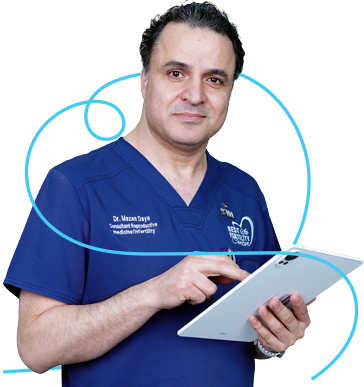
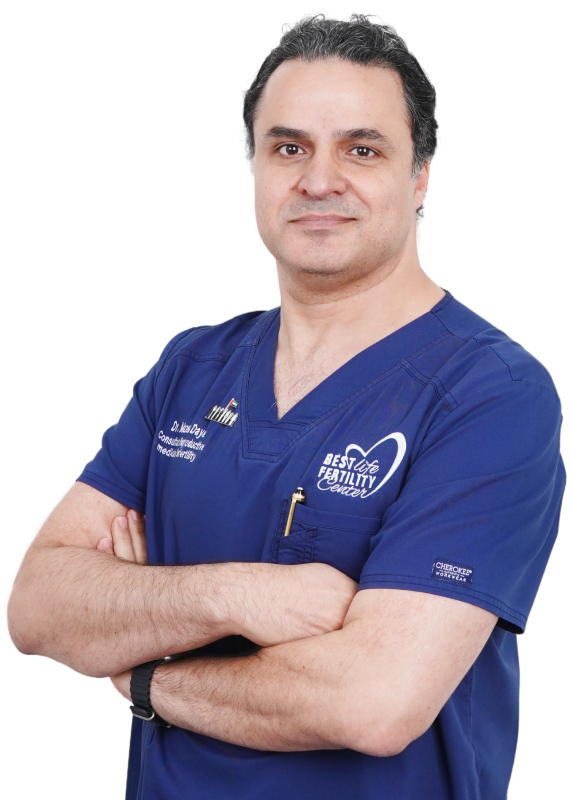
At Best Life Fertility Center, the clinical team is led by Dr. Mazen Al-Dayeh, a Reproductive Endocrinology and Infertility specialist with over two decades of experience, supported by embryologists holding Masters-level qualifications in Assisted Reproduction from internationally recognised universities.
Range of Treatments Available Under One Roof
Fertility medicine is not a single treatment — it is a spectrum. The right clinic should be equipped to offer:
- IUI (Intrauterine Insemination) — for couples with mild fertility challenges or unexplained infertility where less invasive intervention may be appropriate first
- IVF (In Vitro Fertilisation) — the most established assisted reproductive technology globally, combining ovarian stimulation, egg retrieval, laboratory fertilisation, and embryo transfer
- ICSI (Intracytoplasmic Sperm Injection) — essential when male factor infertility is present, including low sperm count, poor motility, or retrieved sperm from surgical procedures
- PGT (Preimplantation Genetic Testing) — chromosomal screening of embryos before transfer, which improves implantation rates and reduces miscarriage risk, particularly in women over 35 or couples with a history of recurrent pregnancy loss
- Fertility preservation — egg freezing and sperm banking for couples who need to delay treatment or preserve options before medical treatment
- Male fertility investigations and sperm retrieval — including PESA, TESA, and TESE for men with azoospermia
A clinic that requires you to be referred elsewhere for any of these services adds delays, coordination complexity, and unnecessary stress to an already demanding process.
Laboratory Quality and Technology
The embryology laboratory is the heart of any IVF centre. Clinical outcomes — fertilisation rates, blastocyst development, implantation success — are directly influenced by the quality of the lab environment, the culture media used, the incubation technology, and the skills of the embryologists working within it.
When evaluating a clinic, it is reasonable to ask about their laboratory accreditation, their equipment standards, and whether they use time-lapse embryo monitoring — a technology that allows continuous, non-invasive observation of embryo development and supports more informed embryo selection decisions.
Transparent Success Rates
Reputable clinics report their outcomes honestly and in context. Look for centres that share:
- Clinical pregnancy rates per embryo transfer (not just positive pregnancy tests)
- Live birth rates, broken down by age group
- Success rates specifically for your treatment type (IVF, FET, donor cycles, etc.)
Be cautious of clinics that quote headline success rates without contextual breakdown, or that make guarantees no ethical clinic can honestly offer.
Personalised Treatment — Not a Conveyor Belt
The most common complaint couples have about their fertility clinic experience is feeling like a number. In clinics with very high patient volumes and minimal consultation time, treatment plans can become generic — the same stimulation protocol applied broadly, the same transfer strategy used regardless of individual response.
The best fertility care is built on a different model: thorough initial assessment, regular review of how each individual responds, and a willingness to adjust the plan when the data calls for it. If a clinic cannot explain why your specific treatment plan was designed the way it was, that is a signal worth taking seriously.
Understanding Your Treatment Pathway: What to Expect Step by Step
For couples new to fertility treatment, the clinical process can feel opaque. Here is a straightforward overview of what the journey typically looks like from first consultation to embryo transfer:
Step 1 — Initial Consultation Both partners are assessed. For the female partner: medical history, cycle history, hormone blood tests (AMH, FSH, LH, oestradiol), and a transvaginal ultrasound to assess ovarian reserve and uterine anatomy. For the male partner: semen analysis, and further investigation if indicated.
Step 2 — Diagnosis and Treatment Planning Your specialist reviews all findings and recommends the most appropriate treatment pathway — which may or may not involve IVF at the outset. Some couples benefit from simpler interventions first; others need to proceed directly to IVF or ICSI based on their specific diagnosis.
Step 3 — Ovarian Stimulation (for IVF) Daily hormone injections stimulate the ovaries to produce multiple follicles. Regular monitoring appointments (ultrasound and blood tests) track the response and allow the stimulation protocol to be adjusted as needed.
Step 4 — Egg Retrieval When follicles reach the appropriate size, a trigger injection is given and egg retrieval is performed under sedation approximately 36 hours later. This is a short, minimally invasive procedure.
Step 5 — Fertilisation and Embryo Culture Retrieved eggs are fertilised with the partner’s (or donor’s) sperm using IVF or ICSI. Resulting embryos are cultured in the laboratory for three to five days and assessed for quality.
Step 6 — Embryo Transfer One or two healthy embryos are transferred to the uterus in a simple, often painless procedure. Remaining viable embryos can be cryopreserved for future cycles.
Step 7 — Pregnancy Test A blood test approximately 10–14 days after transfer confirms whether implantation has occurred.
The Importance of Emotional Support Throughout Treatment
Fertility treatment is not only a medical process — it is an emotional one. Cycles that do not result in pregnancy, the two-week wait, the hormonal effects of stimulation medications, and the weight of hope and uncertainty all take a genuine psychological toll. The best fertility clinics recognise this and provide it as part of standard care — not as an optional extra.
Ask prospective clinics what psychological support they offer. This might include:
- Access to a fertility counsellor or psychologist
- Peer support programmes or patient communities
- Clear communication protocols — so you are never waiting days for a nurse to return your call when you have a concern
A clinic’s culture around emotional support tells you a great deal about how it values the people it is treating, not just the outcomes it is pursuing.
Fertility Treatment in Dubai: Regulatory Standards You Can Rely On
Couples choosing fertility care in Dubai benefit from a robust regulatory framework. IVF clinics operating in the emirate are licensed and monitored under the Dubai Health Authority (DHA) and must comply with UAE Federal Law requirements governing assisted reproductive technologies. As documented in published research on reproductive medicine in the UAE, fertility services in Dubai have developed significantly since the early 1990s, with regulatory oversight now requiring clinics to meet defined standards across staffing, facilities, laboratory practice, and ethical compliance before being permitted to operate.
This matters for couples in Downtown Dubai because it means the bar for licensed fertility care is not arbitrary — it is legally defined, regularly audited, and designed to protect patients at every stage of treatment.
Why Couples Across Dubai Choose Best Life Fertility Center
Best Life Fertility Center serves couples from across Dubai — including Downtown Dubai, DIFC, Business Bay, Dubai Marina, and beyond — providing the full spectrum of fertility investigation and treatment without the need for referrals elsewhere.
What couples consistently describe as the most important factors in their experience:
- One specialist relationship — continuity of care with a named doctor who knows your case in detail, rather than rotating appointments with whoever is available
- Integrated male and female fertility — both partners investigated and treated under one roof, removing the fragmented experience of attending multiple clinics
- Clear communication — treatment plans explained in accessible language, with time for questions, at every stage
- Evidence-based care — treatment protocols built on current reproductive medicine evidence, not outdated defaults or volume-driven shortcuts
If you are looking for the best fertility clinic in Downtown Dubai and want to understand what genuine specialist care looks like in practice, the first step is a consultation where your full picture — both partners — is assessed together.
Conclusion
Choosing where to place your trust during a fertility journey is one of the most significant decisions a couple can make. The best fertility clinic in Downtown Dubai is not defined by its postcode — it is defined by the quality of its specialists, the rigour of its diagnostics, the breadth of its treatment options, and its commitment to treating every couple as the individuals they are, not as cases to be processed.
At Best Life Fertility Center, we have built our practice around exactly that standard of care. If you are ready to take the next step — whether that is a first consultation, a second opinion, or simply a conversation about what your options look like — we are here.
Book your consultation at Best Life Fertility Center →
Frequently Asked Questions
Q: Does the best fertility clinic in Downtown Dubai have to be physically located there?
No. Many top-rated clinics serve Downtown Dubai residents from nearby areas like Sharjah, offering flexible appointments, accessible transport links, and the same standard of care.
Q: When should a couple in Downtown Dubai first see a fertility specialist?
After 12 months of trying without conception (6 months if the woman is over 35), or sooner if there is a known medical history suggesting investigation is needed.
Q: How long does a full fertility workup take before treatment can begin?
A comprehensive assessment for both partners — bloods, ultrasound, semen analysis — is typically completed within one to two weeks, with a treatment plan discussed shortly after.
Q: Is IVF always the first treatment recommended?
Not necessarily. Depending on diagnosis, IUI or hormonal treatment may be recommended first. IVF is advised when these are unlikely to succeed or when the diagnosis makes it the most appropriate starting point.
Q: What questions should I ask a fertility clinic before committing to treatment?
Ask about specialist credentials, live birth rates by age group, laboratory accreditation, what happens if a cycle fails, and what emotional support is available throughout.