Quick Overview
|
If you’ve been going through fertility investigations and your doctor has mentioned the HBA sperm binding test, you’re probably full of questions — and that’s completely understandable. Most people have never heard of it before, and it’s not always explained well in clinical settings.
So let’s break it down — in plain, honest language — so you know exactly what’s happening, why it matters, and what the results could mean for your fertility journey. Whether you’re just starting out or you’ve already been through a few cycles without success, this guide is for you.
What Exactly Is the HBA Sperm Binding Test?
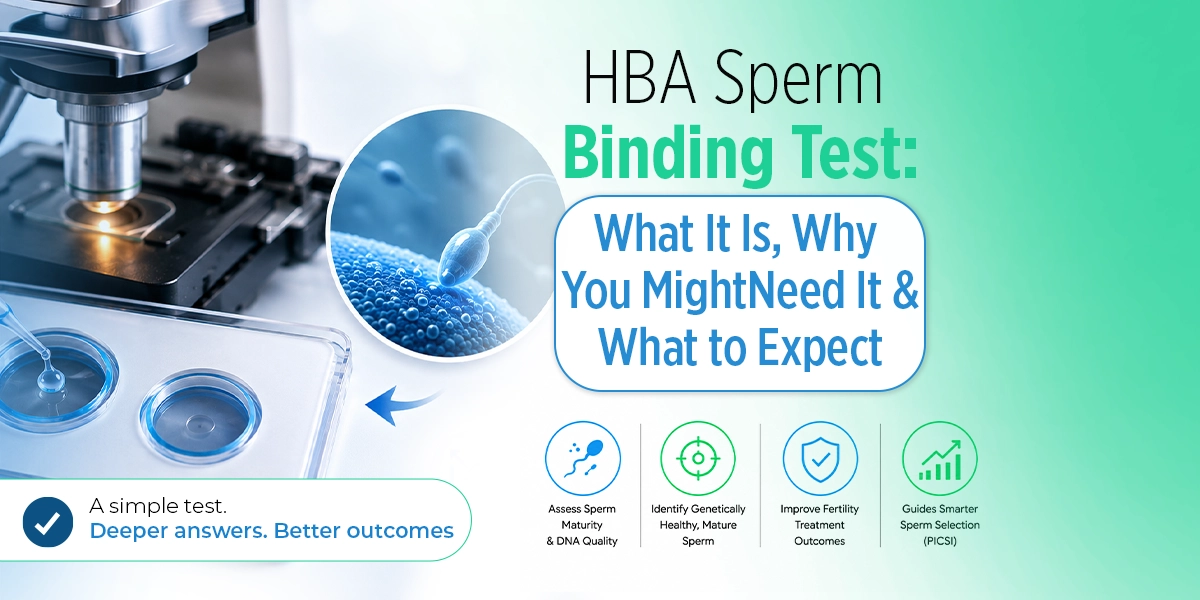
The HBA — short for Hyaluronan Binding Assay — is a specialized fertility test that goes much deeper than a standard semen analysis. While a regular sperm test tells you about count, shape, and movement, the HBA looks at something far more specific: can your sperm actually bind to hyaluronic acid?
Why does that matter? Because hyaluronic acid is the key substance found in the outer layer surrounding a woman’s egg. Only mature, genetically healthy sperm carry the surface receptors needed to bind to it. Immature or DNA-damaged sperm — even if they look perfectly normal under a microscope — cannot bind properly. This is why so many couples with “normal” semen results still struggle to conceive; the standard test simply doesn’t tell the full story.
Understanding male infertility at this deeper level is exactly where the HBA test adds real value — it’s not just about how sperm look, but how they function biologically.
“A standard semen analysis gives us a snapshot — it tells us what we can see. The HBA tells us what we can’t see: whether the sperm’s DNA is intact and whether it is biologically ready to fertilise. I recommend this test for almost every couple who has faced unexplained failure in IVF or ICSI.” — Dr. Mazen Dayeh, Fertility Specialist, Best Life Fertility Center |
How Does the HBA Sperm Binding Test Work? (Step by Step)
Step 1 — Semen Sample Collection
You provide a fresh semen sample, exactly the same way as a routine semen analysis. This is completely non-invasive and takes just a few minutes at the clinic.
Step 2 — The HBA® Slide
The sample is placed onto a specially prepared HBA® Slide (developed by Biocoat Inc.), which is coated with a layer of hyaluronan — the same substance found around the egg in the female body. This recreates the natural environment a sperm would encounter during fertilisation.
Step 3 — Microscopic Evaluation
Using a phase-contrast microscope, an embryologist counts how many motile sperm successfully bind to the hyaluronan layer. The result is expressed as a percentage — the “HBA score.”
Step 4 — Interpreting the Results
HBA Score | What It Means | Recommended Action |
≥ 80% | Normal sperm maturity & function | Standard ICSI or IVF may proceed |
60% – 79% | Mildly reduced maturity | Further assessment; lifestyle review |
< 60% | High DNA abnormality risk | PICSI sperm selection strongly advised |
Who Should Get the HBA Sperm Binding Test?
This test isn’t needed by everyone — but for certain couples, it can be genuinely game-changing. You may be a good candidate if:
- You’ve had one or more failed IVF or ICSI cycles with no clear explanation
- Embryo quality has been poor despite a normal semen analysis
- You’ve experienced recurrent miscarriage
- A DNA fragmentation test came back with elevated results
- You have oligozoospermia (low sperm count) or unexplained male-factor infertility
- You’ve been told your semen parameters are borderline
It’s also worth noting that the HBA sperm binding test is an important part of a broader male fertility work-up. At Best IVF UAE, it sits alongside other assessments within our male infertility treatment pathway — giving your care team a complete picture before any decisions are made.
“In my practice, the couples who benefit most from HBA testing are those where the standard tests look acceptable — but something isn’t working. This test gives us the missing piece of the puzzle, and it very often changes the treatment plan completely.” — Dr. Mazen Dayeh, Fertility Specialist, Best Life Fertility Center |
Equipment Used in the HBA Sperm Binding Test
One of the reasons the HBA sperm binding test is so clinically trusted is that it relies on purpose-built, internationally validated tools — not improvised lab methods. The equipment used matters enormously, and at Best IVF UAE, we use only devices with a proven research and clinical track record.
🔬The CooperSurgical HBA™ Assay — The Gold Standard Device
The primary tool used to perform the HBA test is the HBA™ Assay by CooperSurgical — a global leader in IVF and reproductive technology. This is not just any diagnostic slide. The CooperSurgical HBA™ Assay features a dual hyaluronan-coated chamber design, allowing two measurements from a single semen sample for greater accuracy and reproducibility.
Here is exactly how the device works in practice: a 7–10 µL drop of fresh semen is placed directly onto the assay chamber, a cover slip is applied, and the chamber is then incubated for 10 to 20 minutes at room temperature. During this window, all mature sperm carrying hyaluronan receptors make contact with the coated surface and bind to it — they stop progressive movement but continue active tail beating, which makes them easily identifiable under the microscope. Immature sperm, lacking those receptors, continue swimming freely and are not counted as bound.
The result is the HBA Index — the percentage of motile sperm that successfully bound. The presence of hyaluronan receptors and the ability of spermatozoa to bind is correlated with sperm maturity, increased chromatin integrity, decreased chances of aneuploidy, lower sperm DNA fragmentation, and better sperm DNA packaging. This is why the HBA Index is considered a direct window into sperm genetic health, not just physical appearance.
💡 Why CooperSurgical? CooperSurgical is one of the world’s leading providers of fertility lab equipment and ART consumables. As Steven Fleming PhD, Director of Embryology for CooperSurgical, explains: “HBA and sperm DNA fragmentation assays correlate with fertility prognosis whereas PICSI and SpermSlow increase the likelihood of successful ICSI treatment outcomes.” This is a manufacturer that understands how the test and the treatment connect — and builds their products around that clinical pathway. |
🧪 The Full Equipment Lineup
- CooperSurgical HBA™ Assay — Dual-chamber hyaluronan-coated diagnostic device. The primary tool for quantifying sperm maturity. Simple to perform, results ready within minutes.
- Phase-Contrast Microscope — Allows embryologists to observe sperm binding and tail-beating behaviour in real time, without staining or altering the live sample.
- Counting Chamber (e.g., Makler Chamber) — Used to count at least 100 motile sperm — both bound and unbound — to calculate an accurate HBA Index percentage.
- CooperSurgical SpermSlow™ — A hyaluronic acid–based viscous medium used during sperm immobilisation in ICSI, offering a gentler and biologically compatible alternative to PVP (polyvinylpyrrolidone). Used in conjunction with HBA results to optimise the entire sperm selection workflow.
- PICSI® Dish — When the HBA Index falls below the clinical threshold, the PICSI Dish takes over for treatment. Pre-loaded with hyaluronan microdots, it physically binds only mature sperm — which are then individually selected by the embryologist for injection. The HBA diagnoses; the PICSI Dish acts.
💡 Good to know: The HBA™ Assay, SpermSlow™, and PICSI® Dish all work on the same biological principle — mature sperm bind to hyaluronic acid; immature ones do not. At Best Life Fertility Center, UAE, these tools are used as a connected clinical system, not in isolation. The test informs the treatment, and the treatment uses the same biology to select the best possible sperm. |
What Happens If My HBA Score Is Low?
A low result on the HBA sperm binding test isn’t the end of the road — far from it. It simply means your fertility team needs to work smarter when selecting sperm for treatment.
The most common recommendation following a low HBA score is PICSI (Physiological Intracytoplasmic Sperm Injection). Unlike standard ICSI — where sperm is selected visually based on shape and movement — PICSI uses a culture dish pre-loaded with hyaluronan microdots. Only sperm capable of binding to hyaluronan are picked for injection. This means the embryologist is choosing sperm that have already demonstrated biological maturity, not just the ones that look healthy at a glance.
Research has shown that hyaluronan-binding sperm carry significantly lower rates of DNA fragmentation, chromosomal abnormalities, and faulty gene expression — all of which directly affect embryo quality, implantation, and miscarriage risk. Our IVF/ICSI treatment programme incorporates PICSI as a precision tool for couples where standard sperm selection hasn’t been enough. For couples who have had unexplained losses, our team may also recommend pairing this with genetic screening to build the fullest possible picture before the next cycle.
“When I see an HBA score below 60%, I don’t see a problem — I see an answer. It tells me we need to change our sperm selection strategy. PICSI has genuinely transformed outcomes for couples we would previously have struggled to help. The biology does the selecting — we simply follow what it tells us.” — Dr. Mazen Dayeh, Fertility Specialist, Best Life Fertility Center |
HBA vs Standard Semen Analysis — What’s the Real Difference?
This is one of the questions we hear most often, and it’s a fair one. Here’s a simple way to think about it: a standard semen analysis is a quantity and movement check — it counts sperm, measures how fast they swim, and notes their shape. It tells you a great deal, but it cannot tell you whether the DNA inside those sperm is intact.
The HBA sperm binding test fills precisely that gap. A sperm can look perfectly healthy under the microscope — good morphology, strong motility — and still fail to fertilise an egg because it lacks the genetic integrity needed for successful embryo development. This is why couples sometimes have multiple failed cycles despite a reassuring semen report. The HBA catches what the eye cannot see.
If you’re in that situation right now — normal results, unexplained failures — you’re not alone, and there are answers available. Our patient education resources can help you understand your options, and our specialists are always available to walk through results with you in full.
Can You Improve Your HBA Score?
Yes — and this is one of the more encouraging parts of this conversation. Sperm health is not fixed. Because sperm take approximately 72–90 days to mature, meaningful improvements in HBA scores are achievable within a few months with the right approach.
Research has linked higher BMI, smoking, oxidative stress, and nutrient deficiencies to lower hyaluronan binding capacity. Targeted antioxidant supplementation — including vitamins C and E, coenzyme Q10, zinc, and folate — has been shown to increase both sperm density and HBA binding scores significantly in clinical studies. According to the UK’s Human Fertilisation and Embryology Authority (HFEA), PICSI — which is driven by HBA results — has shown a reproducible signal for reducing miscarriage rates, making sperm quality optimisation before any cycle genuinely worthwhile.
At Best Life Fertility Center, we combine sperm quality testing with our holistic support programme to help men make meaningful improvements before treatment begins — because better sperm going in means better outcomes coming out.
Final Thoughts — Is the HBA Sperm Binding Test Right for You?
If your fertility journey has hit an unexplained wall — whether that’s failed cycles, poor embryos, recurrent pregnancy loss, or simply a gut feeling that something deeper needs investigating — the HBA sperm binding test could be one of the most important diagnostic steps you take.
It’s simple, non-invasive, and clinically powerful. More importantly, it gives your fertility team the information they need to make the right decisions for your unique situation — rather than repeating approaches that haven’t worked. Paired with the right treatment response, it genuinely changes outcomes. Whether you’re planning your first IVF cycle or reassessing after a difficult journey, this is a test worth asking about. And if you’re also navigating female-side factors at the same time, our team handles female infertility treatments alongside male investigations, so nothing gets looked at in isolation.
At Best Life Fertility Center, we believe every couple deserves answers — not just average care. Our specialists are ready to guide you through every step.
Frequently Asked Questions
What is the HBA sperm binding test?
A fertility test measuring the percentage of mature, DNA-healthy sperm that can bind to hyaluronic acid — the natural substance surrounding a woman’s egg.
What is a normal HBA score?
A score of 80% or above is normal. Scores below 60% suggest significant DNA damage and typically lead to PICSI sperm selection for treatment.
Who needs the HBA sperm binding test?
Men with unexplained infertility, repeated IVF/ICSI failures, poor embryo quality, elevated DNA fragmentation, or borderline semen analysis results.
What happens if the HBA test result is low?
Your specialist may recommend PICSI — a technique using hyaluronan-coated dishes to select only the most mature, healthy sperm for injection during ICSI.
Is the HBA sperm test painful?
No. It only requires a standard semen sample — completely non-invasive, with no needles or procedures involved. Results are available within hours.