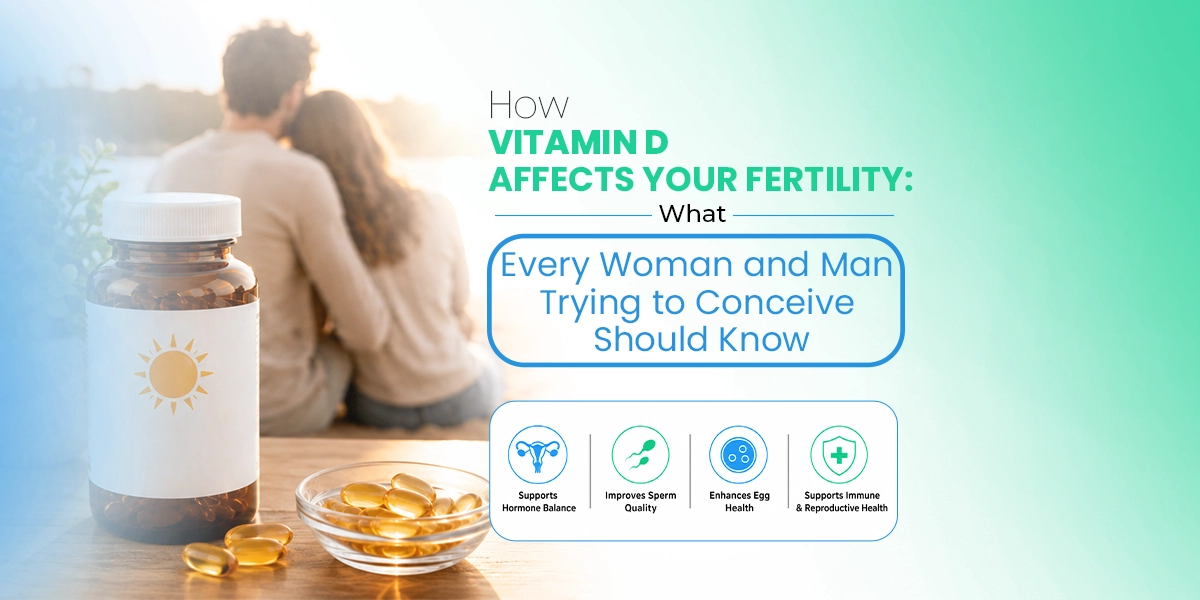
Quick Answer How does Vitamin D affect fertility? Vitamin D affects fertility by supporting ovarian reserve, endometrial receptivity, and IVF outcomes in women, and sperm motility and testosterone levels in men — though evidence varies by individual profile, with the strongest effects seen in women with diminished ovarian reserve or PCOS. |
Vitamin D deficiency is often discussed in the context of bone health, immunity, or fatigue — but for couples trying to conceive, there is a far more specific and clinically relevant story to tell. Understanding how Vitamin D affects your fertility has become one of the more actively researched areas in reproductive medicine over the past decade, and the findings are reshaping how fertility specialists approach pre-conception care.
Vitamin D receptors have been identified throughout the female and male reproductive systems — in the ovaries, the endometrium, the testes, and even within sperm cells themselves. This is not a coincidence. It suggests that vitamin D is doing meaningful biological work in reproduction, not simply circulating passively in the blood. For anyone undergoing fertility treatment, or anyone trying to optimise their chances of natural conception, understanding how Vitamin D affects your fertility is a genuinely useful piece of the puzzle — one that is often overlooked in routine pre-conception checklists.
This article moves past the generic “vitamin D is good for you” messaging and focuses specifically on what the reproductive medicine research actually shows — for both women and men.
Why Vitamin D Deficiency Is So Common — Even in Sunny Climates
It may seem counterintuitive that vitamin D deficiency is a significant concern in a country like the UAE, where sunshine is abundant most of the year. Yet clinical data consistently shows high rates of vitamin D deficiency across the Gulf region. The reasons are largely behavioural and cultural rather than climatic:
- Limited direct sun exposure — modern indoor lifestyles, air-conditioned environments, and long working hours mean many residents spend very little time in direct sunlight
- Sun protection practices — sunscreen, covering clothing, and intentional sun avoidance (often for valid skin health reasons) reduce the skin’s natural vitamin D synthesis
- Limited dietary sources — vitamin D is naturally present in very few foods (oily fish, egg yolks, fortified products), making dietary intake alone insufficient for most people
- Darker skin pigmentation — melanin reduces the skin’s efficiency at producing vitamin D from sunlight, meaning some individuals require significantly more sun exposure to generate equivalent amounts
The result is that vitamin D deficiency is identified routinely in fertility clinics across Dubai, regardless of how much sunshine is technically available outside.
How Vitamin D Affects Your Fertility: The Female Perspective
Vitamin D and Ovarian Reserve
Vitamin D receptors are present in ovarian tissue, and research has explored a potential relationship between vitamin D status and markers of ovarian reserve, including Anti-Müllerian Hormone (AMH). A systematic review and meta-analysis examining this relationship found associations between vitamin D levels and ovarian reserve markers, although the overall picture across studies remains an active area of investigation rather than a settled conclusion.
A more recent prospective study comparing women with diminished ovarian reserve (DOR) to those with normal ovarian reserve found that lower serum and follicular fluid vitamin D levels were associated with reduced fertilization rates specifically within the DOR group — suggesting that vitamin D status may matter more in women who already have reduced reserve, rather than uniformly across all fertility patients.
Vitamin D and IVF Outcomes
The relationship between vitamin D and IVF success has been studied extensively, with genuinely mixed findings. Some studies report that vitamin D deficiency is associated with reduced pregnancy rates following IVF, with the effect appearing to act primarily through the endometrium — the uterine lining responsible for embryo implantation — rather than through egg quality or ovarian stimulation response.
However, not all research agrees. A 2023 retrospective cohort study of 264 women with normal ovarian reserve undergoing their first IVF/ICSI cycle found no statistically significant difference in clinical pregnancy rates between women with severe vitamin D deficiency and those with adequate levels. This is an important and honest finding: it suggests that for women with normal ovarian reserve, vitamin D status alone may not be the determining factor in IVF success that it is sometimes portrayed to be.
The most balanced interpretation of current evidence is this: vitamin D appears more clinically relevant in specific subgroups — women with diminished ovarian reserve, PCOS, or endometrial receptivity concerns — rather than as a universal predictor of IVF outcome for every patient.
Vitamin D and PCOS
For women with polycystic ovary syndrome (PCOS), the evidence is somewhat more consistent. Vitamin D is thought to influence steroidogenesis within the granulosa cells of the ovary — the cells responsible for hormone production during follicle development. Several studies have linked vitamin D deficiency to worsened PCOS symptoms, and supplementation trials have shown improvements in markers such as vascular endothelial growth factor (VEGF) in vitamin D-deficient women with PCOS, correlating with clinical improvement.
Vitamin D and Endometrial Receptivity
Because vitamin D receptors are present in the endometrium, researchers have explored whether vitamin D status affects the uterine lining’s ability to support implantation. The leading theory is that vitamin D’s known anti-inflammatory and immune-modulating properties may help create a more receptive endometrial environment — though this remains a developing area of research rather than a definitively proven mechanism.
How Vitamin D Affects Your Fertility: The Male Perspective
Fertility discussions around vitamin D often focus heavily on women, but the evidence for male reproductive effects is equally worth understanding — particularly since male factor infertility contributes to approximately 40–50% of all fertility difficulties.
Vitamin D receptors and vitamin D-metabolising enzymes have been identified directly within human sperm cells, including in the sperm tail — the structure responsible for motility. This has led researchers to investigate whether vitamin D status correlates with sperm quality, specifically:
- Sperm motility — some studies suggest vitamin D may play a role in calcium signalling pathways within sperm that are essential for normal movement
- Sperm morphology — research has explored potential associations between vitamin D status and the proportion of normally shaped sperm
- Testosterone production — vitamin D receptors are present in the testes, and some studies have found correlations between vitamin D levels and testosterone, although causation has not been definitively established
As with the female research, results across studies are not entirely consistent, and vitamin D should be understood as one factor among many that may influence male reproductive health — not a standalone solution for male infertility. Men with concerns about sperm quality are better served by a comprehensive male fertility evaluation that includes semen analysis and hormonal testing, with vitamin D status considered as part of the broader picture.
What Is Considered a Healthy Vitamin D Level for Fertility?
Vitamin D status is typically measured through a blood test for 25-hydroxyvitamin D (25(OH)D), with results generally classified as:
- Deficient: below 20 ng/mL (50 nmol/L)
- Insufficient: 20–29 ng/mL (50–72 nmol/L)
- Sufficient: 30 ng/mL and above (75 nmol/L and above)
Some reproductive medicine specialists advocate for slightly higher target levels — in the range of 30–50 ng/mL — specifically for women undergoing fertility treatment, based on the subgroup findings discussed above, although universal consensus on an optimal “fertility-specific” threshold has not yet been firmly established by major reproductive medicine bodies.
If you are undergoing fertility treatment or planning to conceive, a simple blood test can determine your current status — a sensible and inexpensive first step before considering supplementation.
Correcting Vitamin D Deficiency Before and During Fertility Treatment
For couples actively trying to conceive or preparing for IVF, addressing vitamin D deficiency is a low-risk, evidence-informed step worth taking alongside other pre-conception preparations:
Sun exposure — 10–15 minutes of midday sun exposure on the arms and legs, several times a week, can meaningfully contribute to vitamin D synthesis, balanced against appropriate skin cancer precautions.
Dietary sources — oily fish (salmon, sardines, mackerel), egg yolks, and fortified foods (some dairy and plant-based milk alternatives) provide modest dietary vitamin D.
Supplementation — vitamin D3 (cholecalciferol) supplementation is the most reliable way to correct deficiency, particularly in climates or lifestyles where sun exposure is limited. Dosing should be guided by your fertility specialist based on your blood test results — self-prescribing high doses without monitoring is not advisable, as vitamin D toxicity, while rare, is possible with excessive long-term supplementation.
Timing relative to treatment — for women preparing for IVF, correcting a significant deficiency several weeks to months before starting a treatment cycle allows levels to stabilise, rather than attempting last-minute correction immediately before a cycle begins.
Vitamin D Is Part of the Picture — Not the Whole Picture
It is worth being clear: no single nutrient, including vitamin D, is a guaranteed fix for infertility. The honest, evidence-based position is that vitamin D deficiency is a modifiable factor that may meaningfully support reproductive health in specific contexts — particularly diminished ovarian reserve, PCOS, and certain cases of male factor infertility — rather than a universal solution.
A 2024 comprehensive review on vitamin D and reproductive disorders concluded that vitamin D deficiency has been associated with reduced pregnancy rates in women undergoing IVF, with the effect likely mediated through the endometrium rather than ovarian stimulation parameters or embryo quality — reinforcing that vitamin D’s role in fertility is real, but specific and nuanced rather than universal.
This is exactly why fertility care should never be approached through a single supplement or lifestyle change in isolation. Vitamin D testing and correction should sit alongside a complete evaluation — including ovarian reserve testing, hormone panels, and, where relevant, a full male fertility workup — so that every modifiable factor is identified and addressed together.
How Best Life Fertility Center Approaches Vitamin D in Fertility Care
At Best Life Fertility Center, vitamin D testing is incorporated into our comprehensive pre-conception and fertility evaluation for both partners. Rather than treating vitamin D as an isolated wellness metric, our specialists interpret your levels in the context of your full reproductive profile — including ovarian reserve, hormone balance, and, for male patients, semen parameters.
Where deficiency is identified, our team provides personalised, monitored supplementation guidance as part of your broader treatment plan — whether you are preparing for natural conception, IUI, or an IVF/ICSI cycle.
Conclusion
Understanding how Vitamin D affects your fertility is no longer a fringe topic in reproductive medicine — it is a genuinely evidence-supported, though nuanced, consideration for couples trying to conceive. The research shows that vitamin D’s impact is not universal, but for women with diminished ovarian reserve, PCOS, or endometrial receptivity concerns, and for men with sperm quality issues, correcting a deficiency may offer a meaningful, low-risk contribution to overall reproductive health.
The most important takeaway is this: vitamin D status should be tested, understood in context, and addressed as one part of a complete fertility evaluation — never as a standalone substitute for proper diagnosis and treatment. If you are trying to conceive, or preparing for fertility treatment, ask your specialist whether vitamin D testing has been included in your workup.
At Best Life Fertility Center, every aspect of your reproductive health — including factors like vitamin D — is assessed as part of one cohesive, personalised plan.
Book your fertility evaluation at Best Life Fertility Center →
Frequently Asked Questions
Q: Does correcting Vitamin D deficiency improve IVF success rates?
Evidence is mixed. It may help specific groups, like women with diminished ovarian reserve or PCOS, more than the general IVF population.
Q: How is Vitamin D deficiency diagnosed for fertility patients?
A simple blood test measuring 25-hydroxyvitamin D levels determines deficiency, with results guiding personalised supplementation as part of fertility treatment planning.
Q: Can Vitamin D deficiency affect male fertility too?
Yes. Vitamin D receptors exist in sperm and testicular tissue, with some research linking deficiency to reduced sperm motility and lower testosterone levels.
Q: How long does it take to correct Vitamin D deficiency before fertility treatment?
Most specialists recommend starting supplementation several weeks to months before treatment, allowing blood levels to stabilise at optimal ranges.
Q: Is Vitamin D supplementation safe during fertility treatment?
Yes, when properly dosed and monitored by a specialist. Excessive unsupervised supplementation should be avoided due to rare toxicity risk.