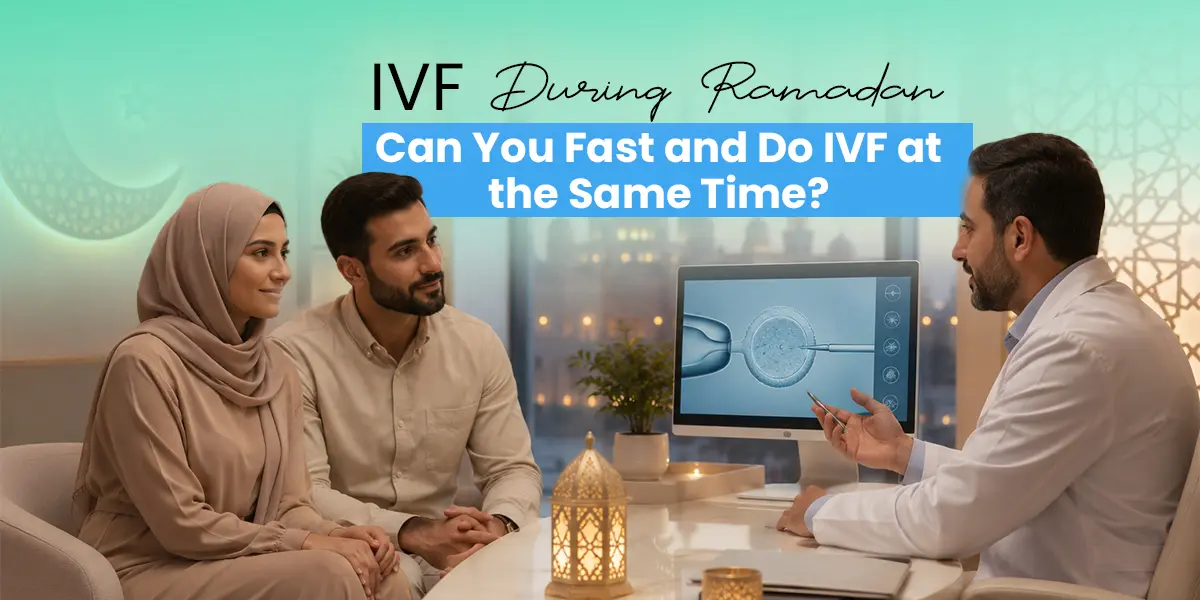
Ramadan is one of the most meaningful times of the year. And for many Muslim couples in the UAE, it also happens to fall right in the middle of their IVF journey.
Every year, I get the same question from couples sitting in front of me: “Doctor, we are fasting. Can we still continue treatment?”
The short answer is: yes, in most cases you can. But the full answer needs a little more care — because Ramadan changes your body, your schedule, and your energy levels in ways that matter for IVF.
This article will walk you through everything you need to know — medically and spiritually — to make the right decision for your treatment.
📌 Quick Answer Most IVF treatments — including injections, blood tests, and scans — can safely continue during Ramadan. The holy month does not automatically require you to stop or delay your cycle. What matters is careful planning, proper nutrition between Iftar and Suhoor, and open communication with your doctor. |
Is IVF Permissible During Ramadan in Islam?
First, let us address what many couples truly need to hear: IVF itself is permissible in Islam. Islamic scholars and fatwas from Sunni institutions across the UAE, Saudi Arabia, Qatar, and Kuwait — issued since the 1980s — have consistently supported IVF for married couples using their own eggs and sperm.
The key conditions are:
- The eggs and sperm must come from the married couple only
- No third-party donors or surrogacy
- The procedure must be medically necessary and performed by qualified professionals
As for performing IVF during Ramadan specifically — Islam allows medical procedures during the holy month, especially when they are time-sensitive or necessary for health. The Islamic Fiqh Council recognises medical necessity as valid grounds for both continuing treatment and, where required, breaking the fast.
🕌 Islamic Ruling on IVF Injections Most Islamic scholars agree that injections — including the hormone injections used in IVF — do not break the fast. They are administered through the skin, not through any natural body opening. Blood draws for monitoring also do not break the fast. This is the position of major scholarly councils in the UAE and GCC. |
What Happens to Your Body When You Fast During IVF?
Ramadan changes your body’s rhythms. Understanding these changes helps us plan your treatment safely:
Hydration
Fluid intake is restricted during daylight hours. For women undergoing ovarian stimulation, dehydration can affect hormonal balance and ovarian response. This is manageable — but it requires being intentional about fluid intake between Iftar and Suhoor.
Sleep Patterns
Many people sleep later during Ramadan, and sleep quality changes. Poor sleep increases cortisol (stress hormone) levels, which can interfere with the hormones needed for ovulation. Aim for 7 to 8 hours of rest, even if the timing shifts.
Nutrition
Your window for eating and drinking is compressed to the hours between Iftar and Suhoor. Getting enough calories, protein, and key fertility nutrients in this window is essential for your IVF cycle.
For Men
Reduced fluid intake during the day can temporarily affect semen volume and sperm motility. This is generally manageable — drinking 2.5 to 3 litres of water between Iftar and Suhoor helps maintain sperm quality throughout the fast.
The Good News: Fasting Can Actually Benefit Fertility
This may surprise you, but there is evidence that Ramadan-style fasting has some positive effects on reproductive health. Research shows that fasting:
- Can improve total sperm count and testosterone levels in men
- Has a beneficial effect on spermatogenesis (sperm production)
- Acts as a form of intermittent fasting — which supports insulin regulation and hormonal balance
- Helps break down accumulated toxins and restore metabolic health
Ramadan is a time of discipline and renewal — and that extends to the body. When managed properly, it does not work against your fertility journey.
When Does Fasting Become a Medical Concern During IVF?
There are specific situations where we advise you to break your fast for medical reasons:
On Egg Retrieval Day
Egg retrieval requires light general anaesthesia or sedation. You will need to be nil by mouth (nothing to eat or drink) from midnight the night before — which aligns with fasting. However, after the procedure, you will need fluids and rest for recovery. Breaking the fast on this day is both medically necessary and Islamically permitted.
On Embryo Transfer Day
Embryo transfer is a lighter procedure, but good hydration supports implantation. We often advise patients to drink water beforehand. If drinking water during the day is required, Islam recognises medical necessity as a valid exemption.
If You Feel Unwell
If you experience dizziness, severe fatigue, or signs of dehydration during your IVF cycle, prioritise your health. Islam explicitly permits breaking the fast when your health requires it. Missed fasts can be made up after Ramadan — a healthy body is the priority.
If you have PCOS or other metabolic conditions, we recommend closer monitoring during Ramadan as hormonal fluctuations may be more pronounced. Our team providing holistic support can work with you on an individualised plan.
⚠ Important Never stop your IVF medications without speaking to your doctor first. Missing a hormone injection — even one dose — during ovarian stimulation can affect your entire cycle. Injections do not break the fast, so there is no reason to skip them. |
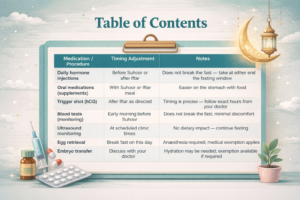
Medication Timing During Ramadan — Practical Schedule
The good news: most IVF medications can be rescheduled to fit your fasting hours. Here is how we typically adjust the plan:
What to Eat at Suhoor and Iftar During IVF
Nutrition during Ramadan is critical for your IVF cycle. You are eating in a compressed window, so every meal counts. Here is what we recommend:
Suhoor — Your Pre-Dawn Meal
Think of Suhoor as your “fertility fuel” for the day. Focus on:
- Slow-digesting carbohydrates: oats, wholegrain bread, brown rice
- Lean protein: eggs, labneh, Greek yoghurt, chicken
- Healthy fats: avocado, nuts, olive oil
- Key fertility supplements: folic acid, iron, Vitamin D (if prescribed)
- 2–3 glasses of water before the fast begins
Iftar — Break Your Fast Right
Do not rush into heavy food at Iftar. Start with dates and water — as the Sunnah teaches — and then eat a balanced meal:
- Omega-3 rich foods: salmon, sardines, walnuts — support egg and sperm quality
- Iron-rich foods: lentils, spinach, lean red meat — especially important for women
- Plenty of vegetables and legumes for fibre and antioxidants
- Continue drinking water through the evening until Suhoor
What to Avoid
- Caffeine — dehydrating and can interfere with hormone levels
- Sugary drinks and sodas — cause blood sugar spikes that affect hormones
- Fried and processed foods — cause inflammation that impacts fertility
- Excessive salt — increases fluid retention and worsens dehydration
🥗 Holistic Support Our team at Best Life Fertility offers holistic nutritional and lifestyle guidance alongside your IVF treatment. Visit our holistic support page to learn how we can support your full fertility journey — not just the medical side. |
Should You Delay Your IVF Until After Ramadan?
This is a personal decision — and there is no universally right answer.
If your cycle is time-sensitive — for example, if you are over 35, your ovarian reserve is declining, or you have a scheduled embryo transfer from a previous cycle — delaying by a full month may not be in your best interest.
If your treatment is more flexible — for example, if you are at an early stage, or if you personally feel that Ramadan is a time for spiritual focus and you would prefer to start fresh after — that is a completely valid choice and we will support it.
What we do not recommend is making this decision based on fear or incomplete information. Come and speak with us first.