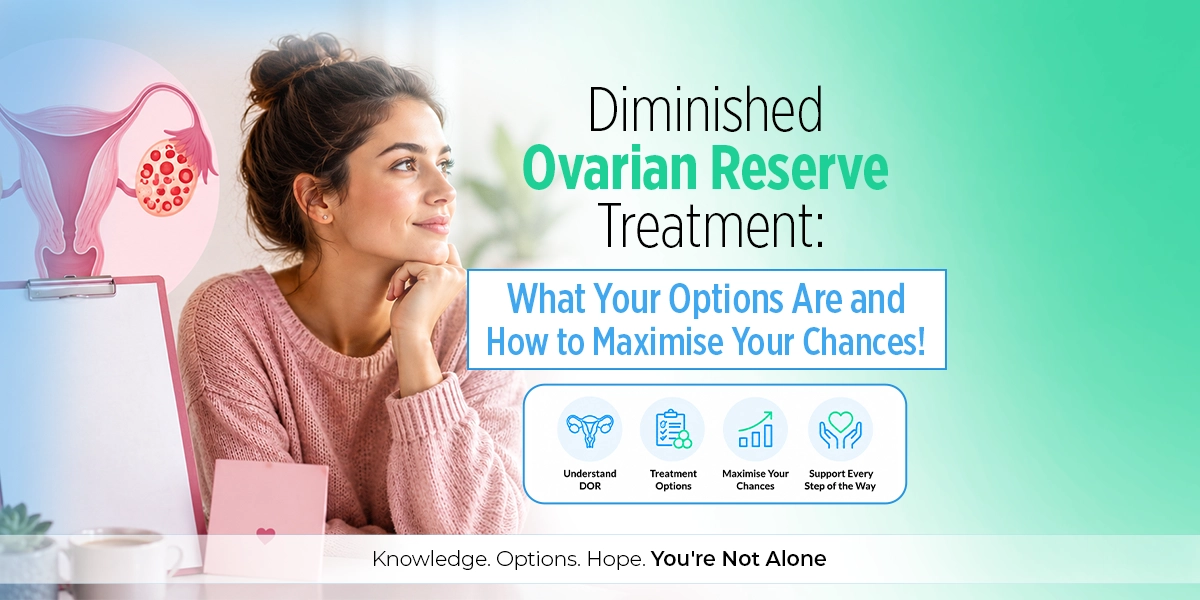
A Low AMH Is Not the End of Your Story
Being told your ovarian reserve is low — whether through a low AMH result, elevated FSH, or a reduced antral follicle count — is one of the most distressing moments a woman can experience in a fertility consultation. It changes the conversation immediately, and for many women, it raises the fear that pregnancy is no longer possible.
The reality is more nuanced than that fear suggests. Diminished ovarian reserve treatment has advanced considerably over the past decade. While no treatment can reverse the biological process of ovarian ageing or restore eggs that are already gone, there is now a meaningful toolkit of approaches — from carefully individualised IVF protocols to emerging regenerative therapies — that give women with low ovarian reserve a genuine path to conception. What matters is not just that treatment is offered, but how it is tailored to your specific reserve, your age, and your reproductive goals.
This guide walks through every evidence-supported option in detail — so you can approach your specialist consultation with a clear understanding of what is available and what questions to ask.
Understanding What Diminished Ovarian Reserve Actually Means
Before exploring treatment, it is worth being precise about what the diagnosis means — and what it does not mean.
Ovarian reserve refers to the number and quality of eggs remaining in a woman’s ovaries. It is not a fixed measure of fertility, but a marker of reproductive potential at a given point in time.
Diminished ovarian reserve (DOR) is diagnosed when that reserve is lower than expected for a woman’s age, based on one or more of the following:
- Anti-Müllerian Hormone (AMH) below approximately 1.1 ng/mL (though thresholds vary between laboratories)
- Basal FSH elevated above 10–12 IU/L on cycle day 2–3
- Antral Follicle Count (AFC) of fewer than 5–7 follicles visible across both ovaries on transvaginal ultrasound
Crucially, DOR is a spectrum, not a binary. A woman with an AMH of 0.8 ng/mL and an AFC of 4 is in a very different clinical position from a woman with an AMH of 0.3 ng/mL and an AFC of 1 — even though both have “diminished” reserve by standard thresholds. Effective diminished ovarian reserve treatment is built around this individual profile, not a single number.
Who Is Affected — and Why It Matters to Act Promptly
DOR affects approximately 10–30% of women presenting to fertility clinics. It is most commonly associated with age — ovarian reserve begins to decline meaningfully from the mid-30s — but it can and does occur in younger women due to:
- Genetic factors — including Fragile X premutation carriers, Turner syndrome mosaic patterns, and other chromosomal variants
- Prior ovarian surgery — particularly procedures for endometriomas or ovarian cysts, which can inadvertently remove functional ovarian tissue
- Endometriosis — particularly when bilateral or involving the ovaries
- Previous chemotherapy or radiotherapy — gonadotoxic treatments can cause significant and sometimes irreversible damage to ovarian reserve
- Autoimmune conditions — in a subset of cases, autoimmune processes target ovarian tissue
- Idiopathic causes — in a meaningful proportion of younger women with DOR, no identifiable cause is found
The reason urgency matters: ovarian reserve declines over time in all women, and more rapidly in those with DOR. Every month that passes represents eggs that will not be available for treatment. Early evaluation and prompt, well-planned treatment gives the best available outcomes.
The POSEIDON Classification: Why DOR Is Not One Condition
One of the most important developments in fertility medicine for women with low ovarian reserve is the POSEIDON (Patient-Oriented Strategies Encompassing Individualize D Oocyte Number) classification, introduced in 2016 and now widely used by reproductive specialists worldwide.
POSEIDON groups poor and low responders to IVF stimulation into four subgroups based on age and ovarian reserve markers:
- Group 1 — Women under 35 with adequate ovarian reserve but an unexpected poor response to stimulation
- Group 2 — Women 35 and over with adequate ovarian reserve but an unexpected poor response
- Group 3 — Women under 35 with genuinely diminished reserve (low AMH and/or low AFC)
- Group 4 — Women 35 and over with genuinely diminished reserve
This classification matters for treatment because it shifts the conversation away from a single “poor responder” label and toward a more individualised strategy. A 29-year-old with low AMH (Group 3) has different treatment priorities and different IVF success probabilities than a 41-year-old with the same AMH result (Group 4), even though both have diminished ovarian reserve by conventional criteria.
Treatment Pathway 1: Individualised IVF Stimulation Protocols
For most women seeking pregnancy with DOR, IVF is the most direct and evidence-supported route. The key distinction in DOR is that standard stimulation protocols designed for women with normal reserve are frequently inappropriate — they can over-suppress the ovaries or miss the optimal stimulation window.
The Antagonist Protocol
The GnRH antagonist protocol is widely considered the most appropriate first-line approach for women with DOR. Unlike the long agonist (down-regulation) protocol, it does not suppress the ovaries before stimulation begins — which is critical when the ovarian response is already limited. Stimulation starts early in the cycle and antagonist medication is added only when follicles reach a specific size, preventing premature ovulation without the drawback of prolonged suppression.
The Flare / Mini-IVF Protocol
For women with very low reserve who respond poorly even to maximum doses of gonadotrophins, a flare protocol or minimal stimulation IVF (mini-IVF) may be the most sensible approach. Rather than attempting to retrieve large numbers of eggs — an unrealistic goal in severe DOR — mini-IVF focuses on retrieving fewer, potentially higher-quality eggs in a gentler cycle. Multiple mini-IVF cycles may be more productive, and less physically taxing, than one maximal conventional cycle.
Stimulation Dose Optimisation
The correct starting dose of FSH/LH for a woman with DOR is not simply the maximum dose — it is the dose most likely to elicit the best ovarian response without the risk of overshooting into a premature or suboptimal response. Your specialist will calibrate this based on your AMH, AFC, age, body weight, and prior stimulation history.
Luteal Phase Stimulation
An emerging approach for women with very low reserve involves starting stimulation in the luteal phase of the cycle (after ovulation) rather than at the beginning. This takes advantage of the secondary wave of antral follicle development that occurs mid-cycle and can yield additional oocytes in women whose early-phase follicle pool is very small.
Treatment Pathway 2: Adjuvant Therapies to Improve Ovarian Response
Alongside IVF protocols, several adjuvant treatments have been studied and are used in clinical practice to support ovarian response in women with DOR. Evidence quality varies, and your specialist will advise which are appropriate in your case.
DHEA (Dehydroepiandrosterone) Supplementation
DHEA is an androgen precursor that has been proposed to improve the intraovarian androgen environment, which plays an important role in early follicle development. Some studies have shown improvements in AMH, AFC, and IVF outcomes following DHEA pre-treatment, though results are mixed across trials. Where used, DHEA supplementation typically begins 6–12 weeks before an IVF cycle and is used at a dose of 25–75 mg daily.
Testosterone Priming
Transdermal testosterone patches or gel applied prior to ovarian stimulation aim to increase intraovarian androgen levels directly, potentially improving follicle sensitivity to FSH. This approach is supported by some randomised trial data and is used in select cases, particularly in poor responders who have not achieved adequate egg numbers in previous cycles.
CoQ10 (Coenzyme Q10)
CoQ10 is an antioxidant involved in mitochondrial energy production — the energy supply within eggs that supports their maturation and quality. As a woman ages, CoQ10 levels in eggs decline. Supplementation (typically 400–600 mg daily for 8–12 weeks before an IVF cycle) is widely used, though robust clinical trial evidence in DOR specifically is still emerging.
Growth Hormone Co-treatment
Growth hormone (GH) adjuvant therapy during IVF stimulation has been studied in poor responders for over two decades. Meta-analyses suggest it may improve oocyte yield and clinical pregnancy rates in selected poor responders, though it is not universally recommended and its use should be guided by your specialist’s assessment of your specific response history.
Treatment Pathway 3: Platelet-Rich Plasma (PRP) Ovarian Rejuvenation
PRP ovarian rejuvenation is one of the most discussed emerging approaches in diminished ovarian reserve treatment. The procedure involves processing a small sample of the patient’s own blood to concentrate the platelet-rich plasma, which contains growth factors thought to stimulate ovarian tissue activity. This PRP is then injected into or near the ovaries under ultrasound guidance.
A 2024 systematic review and meta-analysis published in the Journal of Ovarian Research — examining 38 eligible studies on PRP treatment in DOR patients — found statistically significant improvements in AMH levels, antral follicle count, and both biochemical and clinical pregnancy rates following intraovarian PRP injection, supporting its potential as a meaningful adjunct in selected cases.
PRP is not a standard first-line treatment, and not every woman with DOR will be a suitable candidate. However, for women with very low reserve who have not achieved adequate egg numbers through conventional stimulation alone, or who have experienced premature ovarian insufficiency, it represents a legitimate option to discuss with your specialist. At Best Life Fertility Center, PRP ovarian rejuvenation is available as part of a comprehensive DOR treatment strategy.
Treatment Pathway 4: Egg Freezing and Fertility Preservation
For women with DOR who are not yet ready to attempt pregnancy, or who are facing medical treatments that could further reduce ovarian reserve, egg freezing offers the opportunity to preserve current ovarian function for future use.
The challenge with DOR is that stimulation for egg freezing yields fewer eggs than in women with normal reserve — meaning multiple stimulation cycles may be needed to accumulate a meaningful number of frozen eggs. Despite this, early action is always preferable to waiting: the eggs available now are of better quality than those that will be available in one or two years.
If you have been diagnosed with DOR and are not currently pursuing pregnancy, a conversation with a fertility specialist about proactive egg freezing is strongly recommended — even if the eventual decision is not to proceed, making the decision with full information is always better than acting under time pressure later.
Treatment Pathway 5: Donor Egg IVF
For women with severe DOR — particularly those with very low or undetectable AMH, premature ovarian insufficiency, or repeated IVF failures using their own eggs — donor egg IVF offers the highest pregnancy success rates available.
Using eggs donated by a younger woman with healthy ovarian reserve, fertilised with the partner’s sperm, donor egg IVF bypasses the limitation of the recipient’s own egg supply entirely. Success rates are determined primarily by the donor’s egg quality and the recipient’s uterine receptivity rather than the recipient’s own reserve — meaning women with DOR can achieve pregnancy rates equivalent to those of the general IVF population using donor eggs.
This is an emotionally significant decision that deserves careful, unhurried discussion. At Best Life Fertility Center, our specialists take the time to walk couples through all options — including the full spectrum from personalised own-egg strategies through to donor egg pathways — so that every decision is made with complete information and genuine support.
Lifestyle Factors That Support Ovarian Health
While no lifestyle change can reverse DOR, evidence supports that certain modifiable factors influence ovarian function and egg quality:
Antioxidant-rich nutrition — a Mediterranean-style diet high in vegetables, legumes, whole grains, olive oil, and oily fish provides antioxidants that support cellular health, including egg mitochondrial function.
Healthy body weight — both underweight and overweight status are associated with poorer IVF outcomes; achieving and maintaining a healthy BMI before treatment is beneficial.
Avoiding smoking — smoking is directly toxic to eggs and significantly accelerates ovarian ageing; cessation is one of the most impactful modifiable changes a woman can make.
Reducing alcohol intake — heavy alcohol consumption is associated with reduced ovarian reserve and poorer embryo quality.
Stress management — while stress does not directly cause DOR, chronic high-cortisol states can disrupt the hormonal axis that governs ovarian function. Mindfulness, regular moderate exercise, and adequate sleep all support hormonal balance.
These are not replacements for medical treatment, but they are meaningful supporting factors that your clinical team should be discussing alongside your treatment plan.
What Realistic Outcomes Look Like
Honest expectation-setting is one of the most important things a good fertility specialist provides. For women undergoing diminished ovarian reserve treatment, outcomes vary considerably depending on age, reserve level, cause, and chosen treatment pathway:
| Profile | Own-egg IVF Live Birth Rate (per cycle) | Notes |
|---|---|---|
| DOR, under 35 | 20–40% | Better egg quality compensates partly for low quantity |
| DOR, 35–39 | 15–30% | Quality begins to decline alongside quantity |
| DOR, 40–42 | 10–20% | Cumulative approach (multiple cycles) often needed |
| Severe DOR / POI | 5–15% (own egg) | Donor egg may significantly improve prognosis |
| Donor egg IVF | 50–65% | Largely independent of recipient’s own reserve |
These ranges are drawn from published reproductive medicine literature and represent indicative figures — individual outcomes depend on multiple factors your specialist will assess. The table is not a prediction; it is a context-setter for informed decision-making.
Conclusion
A diagnosis of low ovarian reserve narrows some doors — but it does not close them all. Diminished ovarian reserve treatment today encompasses a sophisticated, evolving range of options: from individualised IVF stimulation and adjuvant hormone therapies, to regenerative approaches like PRP, to egg freezing strategies and, when needed, donor egg pathways that can achieve excellent outcomes regardless of the woman’s own reserve.
What matters most is not simply being offered treatment, but being offered the right treatment — designed around your specific reserve level, age, medical history, and family-building goals. At Best Life Fertility Center in Dubai, that is exactly the standard we hold ourselves to.
If you have received a DOR diagnosis or are concerned about your ovarian reserve, the most valuable next step is a comprehensive consultation — not a generic protocol, but a genuine evaluation of where you are and what your realistic options look like.
Book your consultation at Best Life Fertility Center →
Frequently Asked Questions
Q: Can diminished ovarian reserve treatment ever improve AMH levels?
Some adjuvant therapies — particularly PRP and DHEA — have shown AMH improvements in studies, but results are variable and not guaranteed for every woman.
Q: Is IVF still possible with a very low AMH, such as 0.2 ng/mL?
Yes, in many cases. Egg quality matters as much as quantity; a carefully tailored protocol may still yield viable embryos even with very low reserve.
Q: How many IVF cycles might be needed with DOR?
Most specialists recommend planning for two to three cycles, with a cumulative approach to collecting the best embryos before transfer, depending on response.
Q: Does DOR mean I will go through early menopause?
Not necessarily. DOR indicates reduced reserve but does not predict the exact timing of menopause; however, prompt specialist review and treatment planning is strongly advised.
Q: At what point should donor eggs be considered for DOR?
Your specialist will advise based on age, AMH, AFC, and prior IVF response. It is typically discussed after two or more failed own-egg cycles or in cases of very severe reserve loss.