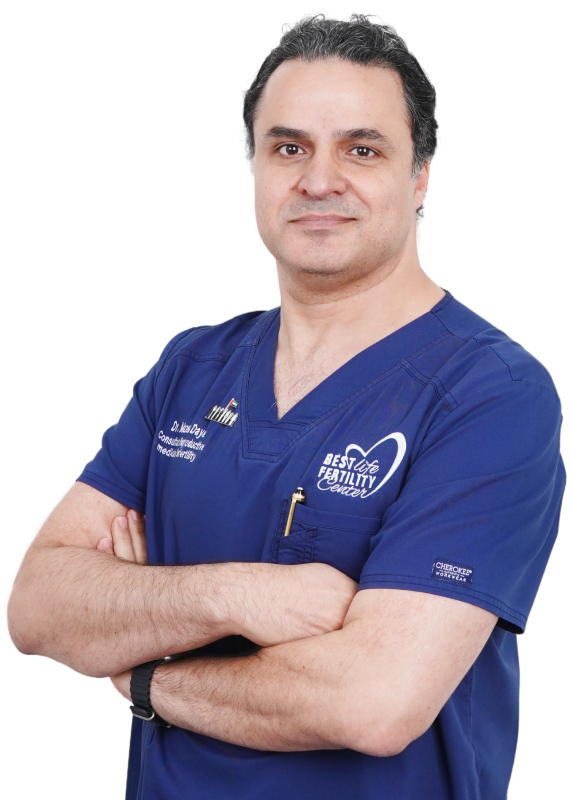

This is probably the question I hear most often at our clinic in Sharjah. Couples come in — sometimes nervous, sometimes tired from trying for years — and the first thing they ask is: “Am I too old for IVF?”
The honest answer? Age matters — but it is not the whole story. Your egg quality, your ovarian reserve, your partner’s sperm health, and the treatment plan you follow all play a role. And with the right approach, many women in their late 30s and even early 40s go on to have healthy pregnancies.
In this article, I want to give you a clear, realistic picture of how age affects IVF — and what your actual options are, wherever you are in your journey. You can explore all our fertility treatments and services at Best Life Fertility.
📌 Quick Answer There is no fixed ‘cut-off age’ for IVF. But IVF success rates do drop with age — especially after 37. The ideal window is your mid-20s to early 30s, but many women over 40 still conceive successfully with the right plan. |
How Age Affects Your Fertility
Every woman is born with all the eggs she will ever have — roughly 1 to 2 million at birth. By puberty, that number drops to around 300,000–400,000. By your 30s, both the number and quality of your eggs start declining. By 35, that decline becomes faster.
This matters for IVF because IVF is not magic — it works with the eggs you have. The better the egg quality, the better the embryo, and the higher the chance of a successful pregnancy.
After 35, eggs are more likely to have chromosomal problems (called aneuploidy). These abnormalities are the main reason for failed implantation and early miscarriage — not the uterus, not the clinic.
What Is the Ideal Age to Start IVF?
If we are talking about pure biology, the ideal age for IVF is your late 20s to early 30s. At that age, egg quality and quantity are both at their strongest, and your body responds well to stimulation medications.
But most people who come to us are not in their 20s. Life in the UAE often means settling in, building a career, finding the right partner, and then starting a family later than earlier generations did. That is completely understandable — and it does not mean IVF is off the table.
If You Are in Your Early-to-Mid 30s
This is genuinely a good time to start IVF if natural conception has not happened after 12 months of trying. Success rates are strong, your body handles the medication well, and you have more flexibility to try multiple cycles if needed.
If You Are in Your Late 30s (37–39)
Do not wait. Every month matters at this stage. A fertility test called the AMH (Anti-Müllerian Hormone) test will tell you how many eggs you have left — your ovarian reserve. Based on this, your doctor can create a plan that maximises your chance of success.
At 37–39, we typically recommend PGT-A genetic testing on embryos to select the healthiest ones, which dramatically improves implantation rates and reduces miscarriage risk.
If You Are 40 or Older
You can still conceive with IVF at 40, 41, or 42 using your own eggs. However, we will be honest with you about the chances and help you decide whether your own eggs or donor eggs give you the best path to parenthood.
Donor eggs — from a younger donor — remove the age factor from the equation. Success rates with donor eggs remain around 50–55% regardless of your age, because the success is tied to the donor’s egg quality, not yours.
💡 Dr. Mazen’s Note I always tell my patients: the best age for IVF is the age you are right now. Waiting does not improve your chances — it reduces them. The sooner you get tested and understand your fertility, the more options you have. |
What About Men? Does Age Affect Male Fertility Too?
Yes — and this often comes as a surprise. While men continue producing sperm throughout their lives, sperm quality does decline with age. After 40–45, there is a gradual increase in DNA fragmentation in sperm, which can affect embryo quality and increase miscarriage risk.
We always assess both partners together. If there are sperm quality concerns, ICSI (Intracytoplasmic Sperm Injection) — where a single healthy sperm is injected directly into the egg — can overcome many of these challenges. Our IVF and ICSI treatments are tailored to each couple’s specific results.
If there are structural issues like varicocele — a condition that affects sperm quality — our team also offers varicocele treatment to improve your chances before IVF.
Should You Consider Egg Freezing Instead?
If you are in your 20s or early 30s and not ready to have children yet, egg freezing is worth a serious conversation. It lets you preserve your eggs at their current quality — essentially “pausing the clock” — so you have more options later.
Women who freeze their eggs before 35 typically get the best results. It is especially worth considering if you:
- Are pursuing a career or education before starting a family
- Have not found the right partner yet
- Have a family history of early menopause
- Are about to undergo chemotherapy or another treatment that may affect fertility
Conditions That Affect Fertility at Any Age
Age is important, but it is not the only thing we assess. Several conditions can significantly affect your fertility regardless of how old you are:
Endometriosis can damage the ovaries and fallopian tubes and affect egg quality. If you have been diagnosed, our team specialises in fertility care for women with endometriosis.
PCOS (Polycystic Ovary Syndrome) is a common cause of irregular ovulation. It actually responds well to IVF stimulation — women with PCOS often produce more eggs per cycle — but requires careful monitoring to avoid overstimulation.
Obesity affects hormone levels and egg quality. Even a modest weight loss of 5–10% before starting IVF can meaningfully improve your chances. Learn more about how obesity affects fertility treatment.
Diabetes — both Type 1 and Type 2 — requires careful management alongside IVF. Our team works closely with patients to optimise blood sugar control before and during treatment. Read more about diabetes and infertility treatment.
The Role of PGT-A Genetic Screening in IVF
One of the most important tools we use — especially for patients over 35 — is Preimplantation Genetic Testing (PGT-A). This test checks embryos for chromosomal abnormalities before we transfer them.
By transferring only chromosomally normal embryos, we significantly reduce the risk of miscarriage and failed implantation. This is why our success rates for older patients are consistently above average.
At Best Life Fertility, 89% of embryo transfers are performed using PGT-A tested embryos. This is not standard practice at every clinic — it is something we invest in because it genuinely makes a difference.
FAQs About Age and IVF
Is there a maximum age for IVF in the UAE?
There is no single universal age limit set by UAE law for IVF, but most clinics — and medical guidelines — advise that IVF with donor eggs is a more realistic path after 45. Every case is assessed individually.
Can IVF work if my AMH is very low?
Low AMH means your ovarian reserve is reduced — but it does not always mean IVF will fail. It means we need to plan carefully. We may use a modified stimulation protocol to get the best response from your remaining eggs, or discuss donor eggs if that gives you a stronger chance.
Does my husband's age matter for IVF?
Yes. Sperm quality gradually declines after 40. We always assess sperm DNA fragmentation alongside the standard semen analysis. If there are issues, ICSI and specific antioxidant protocols can help.
What if I've had failed IVF cycles before?
Previous failed cycles do not mean future cycles will fail. We look at exactly what happened — the embryo quality, the protocol used, the transfer conditions — and adjust the plan. In many cases, switching to frozen embryo transfers (FET) or adding PGT-A testing significantly improves outcomes.
At Best Life Fertility, we start with a comprehensive assessment: AMH test, follicle count ultrasound, semen analysis, and a personalised consultation with Dr. Mazen. Getting tested gives you real answers — not anxiety.
Whether you are 28, 35, or 42, knowing where you stand is the first step toward the right treatment plan. The earlier you test, the more options you have.
If you have been trying to conceive or are concerned about your fertility, do not wait. Let’s create a plan together.